
Do You Actually Read Everything the AI Writes?
요약 · Summary
I asked an AI a 53-character question and got 3,092 characters back. Somewhere along the way I stopped reading it all and started asking the AI which option it liked, then doing what it said. The people who understand AI and brief it precisely will pull ahead, and we're heading the other way.

This morning I sent Claude a one-line request in Korean: "Summarize every blog idea we have so far." Fifty-three characters. The answer came back at 3,092 characters, almost sixty times longer.
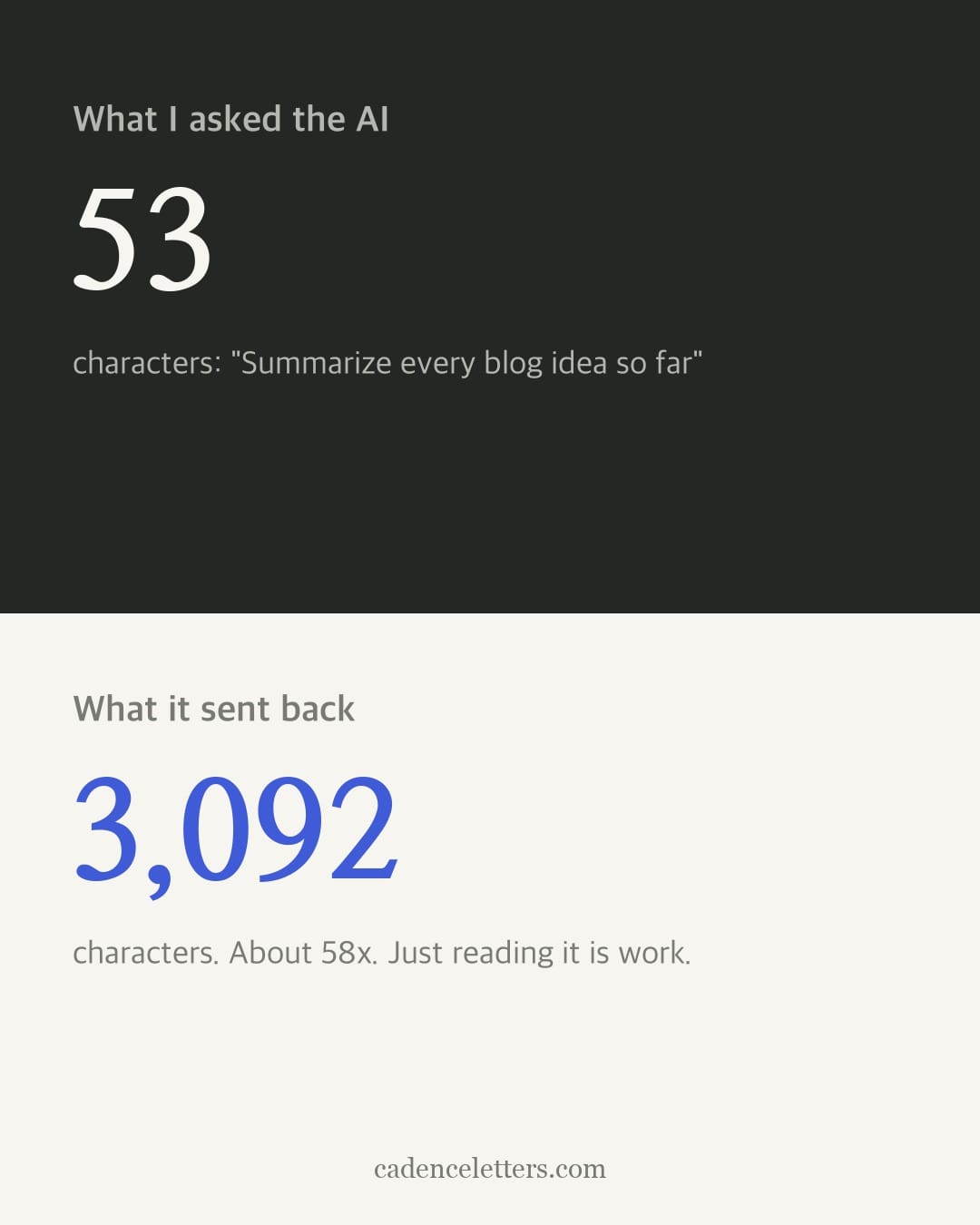
I talk to AI a lot these days, and it's like this every time. I say a little and it pours out a flood of text. So how well I read, how quickly I can work out what the AI is actually telling me, has become a real skill. And so has the other direction: how I hand work to an AI.
But at some point I noticed I was finding it hard to read everything the AI pours out. I was tired of it. Even when a decision came up, instead of focusing and pressing the button myself, I'd ask the AI one more time, "Which one do you think is better?", and then do what it told me. Seeing myself do that was a bit of a shock. In an earlier letter on sign-offs I wrote that as AI workers multiply, the bottleneck becomes my decisions. And there I was, asking the AI to make those decisions for me.
You used to be able to give people work just by telling them out loud. Say it roughly and they'd fill in the context and get on with it. AI gets the work done fast, but understanding the huge context that comes back with it takes a lot of time. How much of that understanding time you can cut is becoming where people compete.
Two people can use the same AI, but the gap between someone who understands the work and then hands it over, and someone who hands it over without understanding, is going to get enormous. I believe the people who understand what AI is saying and give it truly high-resolution instructions to get the results they want will perform far better. That's why I think deeply understanding the work, its context and the whole system it runs in will matter more and more.
And that understanding happens in writing. AI learned from text before it learned to talk. In an essay published on November 22, OpenAI's chief scientist Jakub Pachocki explains that the lab still tracks how capable its models are by how well they predict the next word. They learned by reading enormous amounts of text and guessing what comes next. Voice is just that text turned into speech and back. Understanding what an AI says and handing it work precisely both come down to reading and writing.
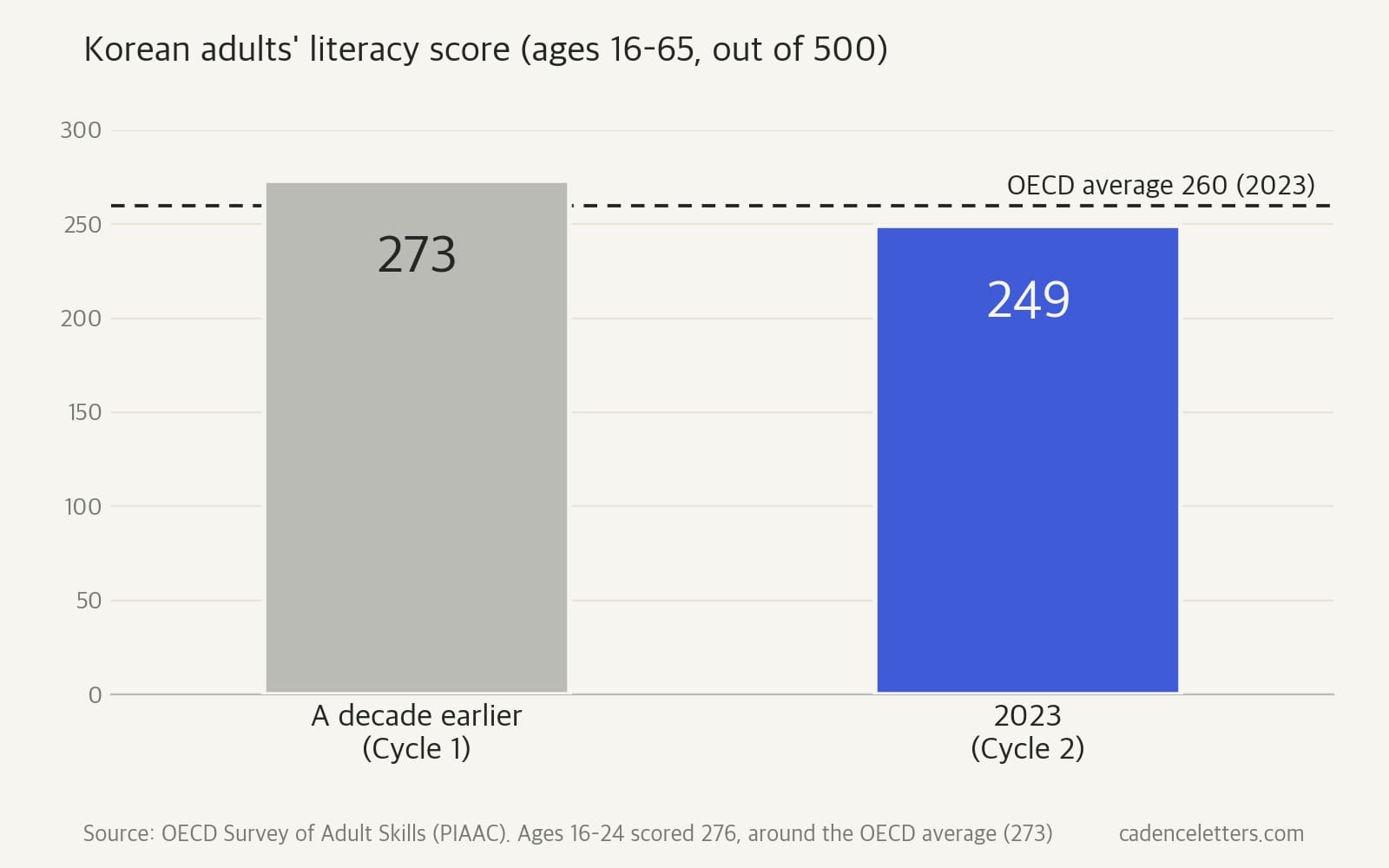
Yet we're heading in exactly the opposite direction: more short videos, fewer books. I was the same. In the OECD's 2023 Survey of Adult Skills, Korean adults aged 16 to 65 scored 249 out of 500 in literacy, below the OECD average of 260 and 24 points lower than a decade earlier. Those aged 16 to 24 scored 276, around the OECD average of 273, and of the 27 countries that took part both times only Finland and Denmark improved, so this isn't just a Korean story. Just as reading matters more than ever, we're drifting away from it. That's quite an irony.
Speaking and listening seem to matter even more between people. Working with AI takes reading closely and writing precisely.
So I decided I should read more, and bought a few e-books on literacy. Books first, videos later.
Sources
- OpenAI: Perplexity and Intelligence (Jakub Pachocki, 2026-11-22)
- OECD: Survey of Adult Skills 2023, Korea
- Etoday: Korean adults' literacy lower than ten years ago (2024-12-10, Korean)
- Video: 3Blue1Brown: Large Language Models explained briefly, The Ezra Klein Show: This Is Your Brain on Deep Reading
- Photo: Library of Congress Main Reading Room (Carol M. Highsmith, public domain)

새 글을 메일로 받아보세요
한국어, 영어 중 받을 언어를 고르세요. 언제든 해지할 수 있습니다.