
Education Comes Down to Motivation and Vision
요약 · Summary
School used to give us knowledge and a network. AI has made knowledge cheap, and the network is forming outside school too. What's left is motivation and vision, and AI may be the teacher that stays with us for life.

I've been thinking about what education is really for.
School used to be where you got knowledge. It was also where you built a network. Now that AI has made knowledge cheap, people say the reason to go to school is the network. I don't think the network will be built around school either. The smartest people used to gather at school. Now the smartest kids are running their own projects and raising money in middle school, or building a reputation of their own in some community.
In San Francisco I once met someone who tutors the children of some of the most successful people in America: kids of big-company chairmen and senior partners at well-known venture firms. According to this person, those kids don't respect their teachers. Their fathers, and the people their fathers spend time with, are so impressive that school doesn't seem worth the effort. So the tutor runs something like the Korean drama SKY Castle, about families who pour money into elite private tutoring. The tutors are UC Berkeley or Stanford graduates who have started a company or two, and they're paid very well, because they're founders the kids' own fathers respect. The most important things in education, this person told me, are motivation and role models.
In my words, a role model is a vision. What we need is motivation and vision, and that's the same thing I wrote about in my last letter: an MTP, a Massively Transformative Purpose.
We have to move past studying to be praised by our parents, our friends and our teachers, past chasing good grades for them. Parents pass away someday (though now that I think about it, maybe they won't). Childhood friends drift away. Teachers can't advise the person you'll become. The only one who can look at your life over the long run and advise you is you.
But now AI can be that advisor. It can stay with you for your whole life, it knows your context, and it's the one you talk to most often.
This isn't wishful thinking. In 1984 the educational psychologist Benjamin Bloom reported that the average student taught one-on-one by a tutor outperformed 98% of students taught in a regular classroom. He called it the 2 sigma problem: tutoring works that well, but no society can give every child a tutor. A 2011 review of many studies put the effect closer to 0.8 sigma than 2, which is still a big difference.
Now AI is starting to fill that seat. In a 2025 randomized trial with 194 students in a Harvard physics course, students who worked alone with a well-designed AI tutor learned more, in less time, than students in an active-learning class run by experienced instructors. In Nigeria, the World Bank had high school students study English with a GPT-4-based assistant after school for six weeks. Scores rose by about 0.3 standard deviations, which the World Bank describes as nearly two years of typical learning.
I think about how to raise my own child. I want to expose her to AI naturally, but I'm afraid that meeting the internet too early will cost her the ability to think for herself. I'd love the relationship to be like one with a teacher: she asks actively, and it answers. If it only becomes a middleman that takes exam questions in and copies answers onto the answer sheet, it means nothing. She has to hit walls along the way, because strength comes from getting over them.
There's research on exactly this. In 2025, a math experiment with nearly 1,000 students at a high school in Turkey found that students given plain ChatGPT-style access scored 48% higher on practice problems, but 17% lower than students with no AI on the exam they took without it. Students who used an AI tutor built to give hints instead of answers mostly avoided that loss. The same AI helps or hurts depending on whether you use it like a teacher or like an answer key.
AI may do anything, but motivation, will and vision are still ours. You can't just tell a computer "build everything." Computers make mistakes and waste effort. It's people who catch that and help the machine get better. And when you become that kind of person, AI rates you highly too.
So a child should grow into someone who sets a direction, not someone who finds answers. Someone who keeps asking what's wrong with AI.
Someone once said that if AI's output makes you uncomfortable, that discomfort is your taste. AI gives every question the most plausible, general and therefore diluted answer. It may come close to correct, but it rarely comes out original.
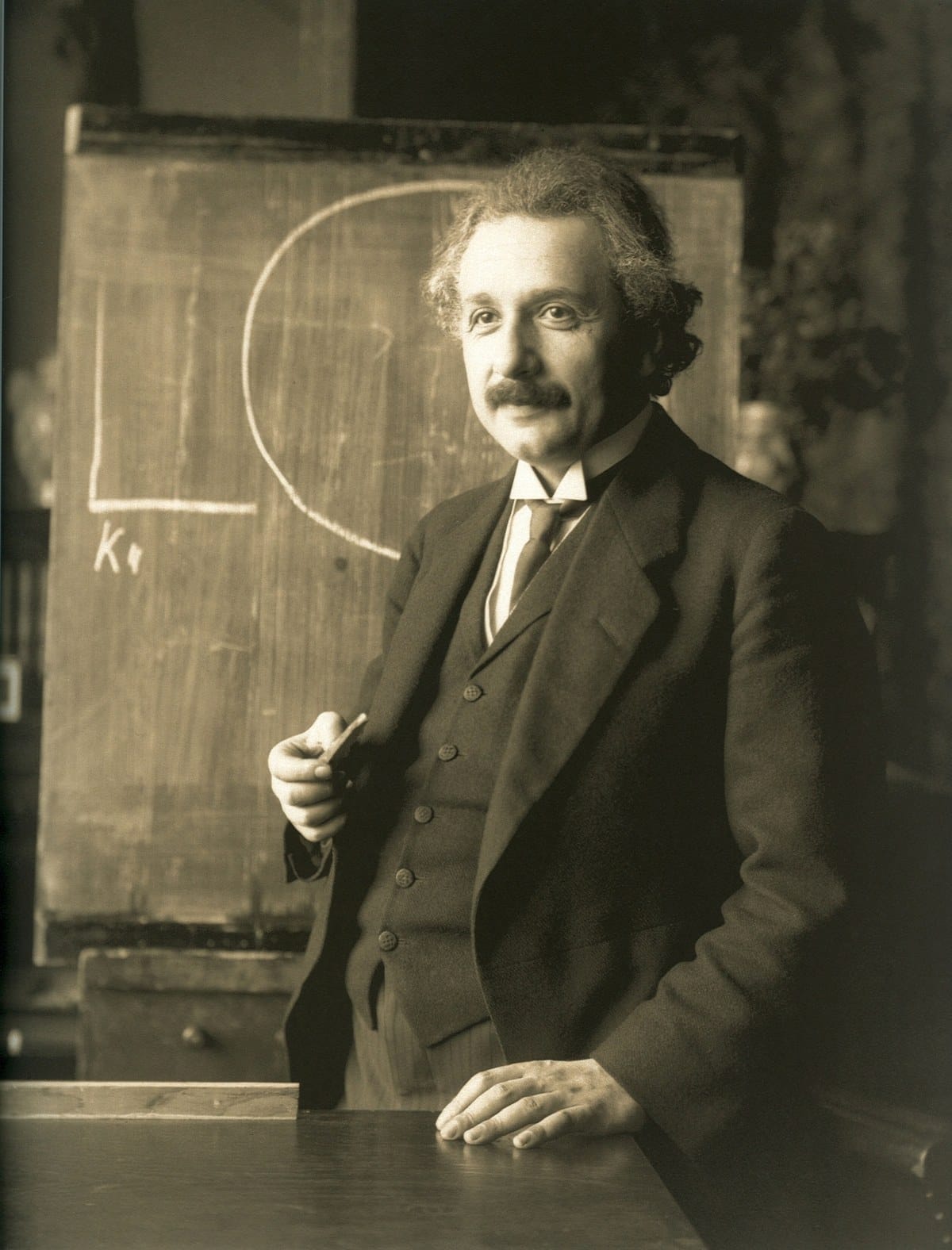
There's a proposal called the Einstein Test: give an AI only what was known before 1905 and see whether it comes up with ideas like relativity on its own. No AI has been confirmed to pass it. Einstein went beyond the consensus of every idea of his time through his own observations. People have to keep reaching past the frontier of what's known, and guide AI down that road.
Sources
- The 2 sigma problem: Bloom, "The 2 Sigma Problem" (Educational Researcher, 1984); follow-up review: VanLehn (Educational Psychologist, 2011)
- Harvard AI tutor trial: Kestin et al., "AI tutoring outperforms in-class active learning" (Scientific Reports, 2025)
- AI tutoring in Nigeria: World Bank, "From chalkboards to chatbots"
- Turkish high school study: Bastani et al., "Generative AI without guardrails can harm learning" (PNAS, 2025)
- The Einstein Test proposal: "The Einstein Test" (arXiv, 2025)
- Photo: Einstein, 1921 (Wikimedia Commons)

새 글을 메일로 받아보세요
한국어, 영어 중 받을 언어를 고르세요. 언제든 해지할 수 있습니다.